

“The Octopus Catcher – Qagyuhl”
Edward Sheriff Curtis (1868-1952)
Curtis is most well-known for producing The North American Indian, which included 700+ larger “portfolio” images along with 1,500+ smaller “volume” sized images to accompany 7,000+ pages of text, which included documentation of tribal history, language, and culture among other aspects of indigenous American life Curtis sought to preserve.
A striking image, “The Octopus Catcher – Qagyuhl” captures a successful octopus hunter studying his quarry. The Kwakiutl First Nation people call western British Columbia home and were called Kwakwaka’wakw before the arrival of Europeans. Today the name Kwakiutl only refers to people from Fort Rupert.
There are less than 300 original photogravures published of each image by Curtis, many bound editions are owned by institutional collections (art museums, libraries, universities, etc.).
Title:
“The Octopus Catcher – Qagyuhl”
Material:
Photogravure on paper
Unframed
7 1/8 × 5 1/16 in. (18.1 × 12.9 cm)
Edition:
1914
Original photogravure from original 272 complete published sets
Volume 10 on ValGelder
Price:
$1,450
Inquire for purchase: NWFineArtPrints@gmail.com
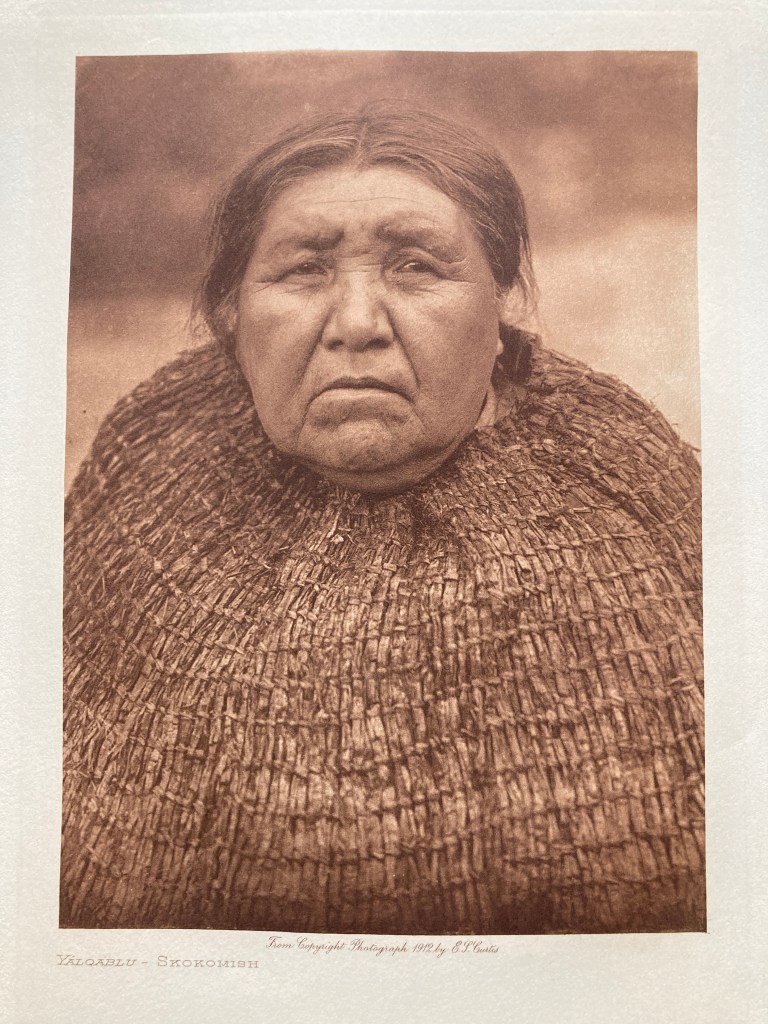
“Yalqablu – Skokomish”
Edward Sheriff Curtis (1868-1952)
Curtis is most well-known for producing The North American Indian, which included 700+ larger “portfolio” images along with 1,500+ smaller “volume” sized images to accompany 7,000+ pages of text, which included documentation of tribal history, language, and culture among other aspects of life Curtis sought to preserve
An intimate and compelling image, the portrait of Yalqablu of the Skokomish Tribe, as it’s known today is unique in the fact that it is a close up, outdoor portrait. Most of Curtis’s portraits were commonly heavily staged and indoors, and his outdoor photos were often of subjects seeming to go about everyday tasks, never looking near, or directly at, the camera (in this case). The people of the Skokomish Tribe are actually “composed of Twana Indians, a Salishan people whose aboriginal territory encompassed the Hood Canal drainage basin in western Washington State.” according to the present-day Skokomish Indian Tribe.
There are less than 300 original photogravures published of each image by Curtis, many bound editions are owned by institutional collections (art museums, libraries, universities, etc.).
Title:
“Yalqablu – Skokomish”
Material:
Photogravure on paper
Unframed
7 1/8 × 5 1/16 in. (18.1 × 12.9 cm)
Edition:
1912
Original photogravure from original 272 complete published sets
Volume 9 on ValGelder
Price:
$1,100
Inquire for purchase: NWFineArtPrints@gmail.com

“Spidis – Wishham”
Edward Sheriff Curtis (1868-1952)
Curtis is most well-known for producing The North American Indian, which included 700+ larger “portfolio” images along with 1,500+ smaller “volume” sized images to accompany 7,000+ pages of text, which included documentation of tribal history, language, and culture among other aspects of life Curtis sought to preserve.
The New Mexico Art Museum also owns the same image, and describes Edward Curtis and the image as such:
“Curtis was passionate about recording the lives of Native Americans, whom he saw as a “vanishing race.” His intentions now seem misguided and his methods clumsy, but his portraits of indigenous North Americans provide an important record. The subject of this picture, Spidis, was probably of the Wisham people who lived along the Columbia River in Oregon. Known as extraordinary fishermen, by the time of Curtis’s visit the tribe’s population had been decimated by diseases introduced by Europeans and their culture compromised by treaties that cut them off from their traditional lands and fishing.Object Notes
Portrait of Spidis (needs diacriticals), probably a member of one of the Wasco-Wishram tribes of Native Americans residing along the Columbia River in Oregon. Lewis and Clark encountered them. Curtis also photographed a Wishram woman with the same kind of nose ornament. The Wishram people now live on the Yakima Reservation in Washington.”
There are less than 300 original photogravures published of each image by Curtis, many bound editions are owned by institutional collections (art museums, libraries, universities, etc.).
Title:
“Spidis – Wishham”
Material:
Photogravure on paper
Unframed
7 1/8 × 5 1/16 in. (18.1 × 12.9 cm)
Edition:
1910
Original photogravure from original 272 complete published sets
Volume 8 on Tissue
Price:
$1,850
Inquire for purchase: NWFineArtPrints@gmail.com

“Lifting The Net – Quinault”
Edward Sheriff Curtis (1868-1952)
Curtis is most well-known for producing The North American Indian, which included 700+ larger “portfolio” images along with 1,500+ smaller “volume” sized images to accompany 7,000+ pages of text, which included documentation of tribal history, language, and culture among other aspects of life Curtis sought to preserve.
“Lifting The Net – Quinault” shows two fisher people lifting fish out of nets into a canoe, likely off the Pacific Coast of the Olympic peninsula. According to the Quinault Indian Nation,
“The Quinault Indian Reservation is a land of magnificent forests, swift-flowing rivers, gleaming lakes and 23 miles (37 kilometers) of unspoiled Pacific coastline. Its boundaries enclose over 208,150 acres (84,271 hectares) of some of the most productive conifer forest lands in the United States . Located on the southwestern corner of the Olympic Peninsula, its rain-drenched lands embrace a wealth of natural resources. Conifer forests composed of western redcedar, western hemlock, Sitka spruce, Douglas-fir, Pacific silver fir and lodgepole pine dominate upland sites, while extensive stands of hardwoods, such as red alder and Pacific cottonwood, can be found in the river valleys. Roosevelt elk, black bear, blacktail deer, bald eagle, cougar, and many other animals make these forests their home.”
There are less than 300 original photogravures published of each image by Curtis, many bound editions are owned by institutional collections (art museums, libraries, universities, etc.).
Title:
“Lifting The Net – Quinault”
Material:
Photogravure on paper
Unframed
7 1/8 × 5 1/16 in. (18.1 × 12.9 cm)
Edition:
1912
Original photogravure from original 272 complete published sets
Price:
$1,350
Inquire for purchase: NWFineArtPrints@gmail.com
 Northwest Fine Art Prints